No More Buildings For Seniors – What We Need Is More Homecare Dollars

We know that as seniors age we often need support. So let’s explore ways to keep us in our homes with those supports. This saves governments money and keeps seniors happier, healthier and safer.

Most studies say that seniors need:

  1. A sense of community
  2. Nutritious food
  3. Physical acitivty
  4. Independence

While most of us plan for retirement, how are we planning for our more senior years? What have you done to explore answers to questions like:

  1. If I have difficulty bathing or keeping my personal care up, what will I do?
  2. If my eye sight is failing how will I complete household chores?
  3. If I’m eating tea and toast for many meals, what can I do so I don’t become malnoursished?
  4. If I’m finding a trip to the bank or paying bills online difficult, what will I do?
  5. If I find medications on the floor or I forget to take medicine what can I do?
  6. If I can no longer drive, what will I do?

There are a smattering of programs that support seniors with such questions however at this point accessing them is a nightmare. And to hire enough private help is cost-prohibiting.

I watched my parents and my in-laws age and as tasks become more and more difficult and their caregivers began to wear out, the only option was to move to a care facility. Homecare could not provide enough support. While it sounded good on paper, when trying to access it, it was not.

A friend sent me an article on a program that aims to keep seniors out of nursing homes. You can find it by going to CBC – The Title is: Keeping Seniors Out of Nursing Homes. It was on the National News one week ago. The program that is highlighted is called PACE. It costs 40% less than having people in nursing homes. This makes sense.

Here is the link: www.cbc.ca/player/play/1990992963636

It’s time to let your Governments know that putting dollars into programs that support seniors need to be directed to Homecare or programs like PACE. We are the ones who can make this change happen. Act now!

Senior Population Increasing by 4% Per Year – While Everyone Says Changes Are Needed in Care, Nothing Significant Is Happening

I just listened to a radio program called The Current on CBC titled Fixing Long-Term Care After Devastation of the Pandemic. You can listen to this 33 minute podcast by going to www.cbc.ca , then find The Current with Matt Galloway and find that title.

Three people were interviewed:

Tamblyn Watts CEO CanAge www.canage.ca

Dr. Quoc Dinh Nguyễn, Geriatrician and Researcher at the University of Montreal Hospital

Dr. Bob Bell, Former Deputy Minister of Health and Long-Term Care Ontario

They talked about how we need to modernize, expand and standardize Home Care and Long Term Care across the country. We need to hold our governments accountable and if national standards for Long Term Care(LTC) are put in place, which we all know are desperately needed, that the Federal Government needs to properly fund the provinces. This would mean structural changes as well as a dedicated Seniors Care Transfer Payment along with a Health Care Transfer Payment.

The Federal Government cannot expect Provincial Governments to make the structural changes unless they properly fund the provinces. This is why it is extremely important to look at each Federal Party’s Platform and see who is willing to do what has been researched, documented and talked about for decades -properly fund seniors’ care.

One issue this panel raised, that I hadn’t thought about before, is that because the increase in our aging population is gradual about 4 % per year, it is not top of mind for most people. One speaker said we should look at the way we care for our seniors just as we do for climate change – if we don’t do something now, the fallout will be catastrophic. It would be costly to set up, yet will have long-term benefits for all.

Don’t let the care of seniors become a footnote, let’s keep it top of mind for all.

Question Your Federal Candidates….let’s make the care of seniors in Long Term Facilities a top priority this election

In the Throne Speech one year ago Prime Minister Trudeau promised to work with the provinces and territories to set national standards for long-term care (LTC). When the 2021 budget was recently released there was no mention.

What he did say was that The Health Standards Organization and The Canadian Standards Association had joined together to launch updated standards for LTC. No mention of accountability for LTC.

What scares me is that close to 70% of all long-term care homes in Canada are accredited according to the existing standards! 83 % in Ontario and 100% in Quebec. So the existing ‘accreditation’ did not stop the horrors that continue to happen to our seniors who are in LTC. Those of us who have had seniors in such facilities are not surprised.

What surprises me yet again, is nothing is being done to change this travesty.

Right now here is the existing accreditation criteria:

  1. voluntary opt-in
  2. self-regulation
  3. run by private bodies
  4. LTC homes pay for the assessment
  5. results of assessment are not made public
  6. achieved through buying products and services
  7. does not measure staffing hours
  8. does not measure quality of care
  9. no accountability processes
  10. no fines/punitive measures
  11. has not prevented COVID deaths

Isn’t it a sign of insanity to keep doing the same thing and expect better results? While our Federal Government is prioritizing funding for support of not-for-profit child care why have they forgotten our most vulnerable seniors? Once again it appears that no one cares.

In March of 2021 advocates representing more than a million Canadians came together to establish national standards for long-term care. (Source: Ontario Health Coalition)

They asked for the Federal Government to commit to ongoing funding for long-term care with clear criteria requiring provinces to improve quality, accountability and take profit out of senior’s care.

The systematic failures during the pandemic exposed deep long-standing issues. We should be ashamed of the unspeakable neglect and death that occurred. And will occur again, if nothing changes.

Because of the lack of funding for public care and the need to make a profit for private care many LTC workers are thrown into complex clinical solutions without adequate training. It is estimated that unregulated, nonprofessional workers provide 75-80% of direct care to nursing home residents in Canada.

Long-term care homes are not part of the Canada Health Act!!! If LTC was under the Canada Health Act, there would be an obligation for the Federal Government to fund and take some measure of ongoing responsibility and accountability for the sector. (Proposed National Standards for Long-Term Residential Care, Goldblatt Partners, Steven Shrybman)

Questions to ask your Federal Candidates could include:

  1. why isn’t LTC under the Canadian Health Act
  2. why aren’t there Federal standards for LTC when all research shows it is needed – if they are in agreement ask for timelines

From what I have read Premiers don’t want the Feds taking over LTC standards. It appears to me that Provincial Governments could have instituted regulations that ask for accountability, surprise inspections, measures of staffing levels or care hours and the ability to impose punitive measures or fines when criteria is not met, they have not.

The Feds need to step up and take responsibility, just as the many reports gathering dust have outlined. Justin Trudeau directed the Minister of Health in a letter dated January 2021 – “For the Minister of Seniors, to work with the provinces and territories to set new, national standards for long-term care so that seniors get the best support possible.”

Isn’t it obvious that until Federal Standards are imposed nothing will change.

Let your voice be heard! Ask all the candidates in your area what they are going to do about setting federal standards for LTC facilities as well as placing these facilities under the Canada Health Act.

Write letters to the editor of you newspaper, ask questions at forums or if a candidate comes to your door. You can make a difference. Don’t let this important topic be forgotten, yet again.

What Can We Do Because If We Are Blessed We Will Live a Long Life….And If We Do, In The Existing Care System ,The Outlook Isn’t Rosy!!!!

I’ve been working for the past 18 months on a memoir of my caregiving experiences. My husband and I had four parents, all living close by, and as they aged we became their caregivers and advocates. We did it willingly and lovingly and yet by the end we were exhausted.

It was an interesting and I think, a unique experience because our two sets of parents approached aging very differently. I thought I could write a book that would help baby boomers plan for their future and hopefully make the lives of their future caregivers a little easier.

My husband’s parents did not want to acknowledge they were aging so made no plans for their future. They would not accept help and resisted any kind of support that would have made their lives, as well as ours, much easier. They said the only way they would leave their home was in a hearse. Unfortunately it was in an ambulance and when we began the long, back-breaking and emotionally draining process of cleaning out their home we vowed we would never do this to our kids.

My parents had all their plans in place. They had downsized twice, had purchased their final resting place, had a file folder with funeral plans and made it clear that they did not want heroic measures at the end of their lives.

My Dad was the only driver and he told us that when we thought he could no longer drive we were to tell him. We did, and he never drove again. They also said they did not want to be a burden and if we thought they needed to move into a care facility we were to tell them. We did, and they moved.

What we came to understand is that even though my parents had all their plans in place it was still difficult. What made it better was that when we made a decision about their care when they no longer could, we knew we were doing what they wanted, even when we could tell they weren’t pleased.

With Bob’s parents, we felt like we were constantly disappointing them. When the medical people said that they needed support in their home, they resisted. When they were no longer able to stay in their own home after a medical crisis, we had to make the decisions, knowing none would be satisfactory for his parents. This was emotionally draining.

What have we learned? First we have already downsized, have bought our final resting place and have been busy during the pandemic trying to get our financial affairs as simple as possible. We are trying to keep in good physical shape and maintain our health. We have been very straight-forward in telling both our kids about our final wishes. We have completed the legal documents needed in hopes of making it as easy as possible for our children.

Because in Alberta, there is not one government department that handles seniors, trying to access support and care is a nightmare. We did it four times and every time it was horrible. We never got the same answer and spent hours and hours on the phone on hold, or being transferred, or being told they no longer handled that aspect of senior care. With so many seniors it only makes sense to have one ministry handle it.

There is not one place to ask questions or find answers. I asked about a portal where ‘all things about seniors’ could be found. The answer, from a government employee, was that “things change so often it would be impossible to keep such a site up to date!” Does this not appal you?

The existing system of care for seniors was set up years ago. Because we are living longer with more complex medical needs we need different care. What worked 50 year ago does not work today and as I visited my three grandparents in nursing homes I didn’t think it was working all that well 50 years ago either…..yet nothing has changed…..and in some cases the same buildings are still being used!

Aging is not a medical issue that more pills, unnecessary medical tests or operations can fix. I know that more rooms in these mini-medical facilities (we call assisted living or SL4 care etc.) are not the answer. Nobody I know wants to end up there!! Yet there are no other affordable options.

We need our government to acknowledge that the system is broken and instead of pointing fingers, or saying during news conferences things must change, they need to sit down and make some radical changes based on what seniors today actually need.

My dream would be that there were smaller facilities, more home-like and the focus of care was on individual needs. While on paper most facilities say they focus on individual care, they do not. In the existing models it is impossible. I witnessed it in the three facilities our parents were in.

Big dark dining rooms where meals are handed out to silent guests is heart-breaking. My parents loved chatting at meal times yet when sitting with other seniors with hearing impairments and cognitive issues it soon was not something to look forward to. If staff were required to sit at each table, eat with their guests and chat, I know guests would look forward to this part of their day. They would get social stimulation and this would be as simple fix. In the existing institutional-type of facilities there are very few parts of the days, guests look forward to.

What we learned from the pandemic is that the air filtration systems are not safe and must be replaced. Also to leave seniors in places where there is no air conditioning should be considered a crime. (These two issues are also common in our schools) Perhaps it is time we charged the people who are making these decisions.

We know that most seniors would prefer to stay in their own homes, yet few can with the existing home care formula. It would be much more cost effective if our governments funded more home care hours per patient than uprooting them and placing them in a facility.

The seniors I know who stay in their own homes either have a huge bank account to fund their care or they have family members who have taken on this full time role, usually at the expense of their own personal health.

Baby boomers need to be vocal. We need to hold our politicians accountable. Write letters, ask questions and don’t let this go. Ask for specific timelines for change and don’t take ‘we are working on it’ as an answer. “They” have been working on it for years…We need action NOW.

An easy first step is to place all senior care under one ministry. Insist that there is a government portal where those of us who need information regarding seniors can go.

Also look at specific education for staff who deal with seniors. Seniors need a different kind of care than a hospital patient. Also look at the types of staff roles needed – depression is a huge issue in seniors, as is mobility and the importance of laughing and socializing. Seniors don’t need more pills they need more compassionate care as they prepare for the end of their lives.

The pandemic highlighted that the way we care for our seniors is a huge problem that cannot be ignored. Don’t let our politicians point a finger at another department… that has happened for far too long. Stand up and take action today. It is evident that the squeaky wheel does get the grease.

Just In Case Binder – being thoughtful to those left behind

Photo by Olya Kobruseva on Pexels.com

Some readers asked me about the “Just In Case” binder. It is a resource you can use to put all information someone would need if you become incapacitated or pass away.

While many don’t like to think about this topic, this binder is a valuable resource for putting your affairs in order. It would contain pertinent information readily available and all in one spot.

Categories include: Executor information, Financial information, Funeral service/celebration of life, Life insurance policies and pension information, Enduring power of attorney and health care directive etc.

I know it would have been a huge help to us as we settled our parent’s affairs.

There is a Canadian website where you can learn more and even purchase one ($50) if you wish – this resource was developed in 2014 and has since been updated.

For information go to: http://www.saskatooncommunityfoundation.ca or you can phone 1-306-665-1756. I think it is well worth the money.

I also Googled “Just in Case” and there were various websites where you can print off worksheets that might accomplish the same thing.


On May 4th I was having a restless night so about 1:30 a.m. I reached for my phone and the next thing I knew I was lying on my right side on the wooden floor by our bed.

I felt a sharp pain in my back, low on the right side and couldn’t catch my breathe. I stayed still for a couple of minutes till I got my breath, stood up and thought “I wonder if I’ll have bruises from that stupid move.”

I got back into bed, beside my snoring husband, but soon realized the pain was too much. I got up, took a couple of pain pills and went out to the living room to read.

Once I became suitably sleepy I crawled back into bed (husband still snoring) and slept for a couple of hours. When I woke up and moved I realized that the pain had not gone away.

While I never had an x-ray because there is nothing that can be done for cracked or broken ribs my Chiropractor said I had probably cracked a rib.

My dad had broken ribs. (I think he was about my age) He was thrown from a horse and his ribs punctured his lungs. He had difficulty breathing so had to be hospitalized. I was not having trouble breathing although it did hurt to take a breath.

I read ‘Dr. Google’ and watched for any other worrying symptoms. I had none, other than a sharp pain when I breathed, turned or heaven forbid, coughed or sneezed.

Now, five weeks post fall, I’m not thinking ‘ouch’ every time I move.

The Chiropractor said to walk lots to keep the blood flowing to the injured spot and for the first week it was a slow, painful go. He was able to ease the muscle spasms.

You might be asking why I went to a chiropractor? My family physician had given up his practise due to all the shenanigans of our UPC government. I trust my Chiropractor as I have been seeing him for over 8 years so knew he would refer me if that was needed.

The moral of the story is that this experience brought to light how vulnerable we are and how in seconds or minutes our lives can suddenly change.

I was lucky. While painful, it wasn’t life-altering. Mostly I was embarrassed and then angry that I had done such a silly thing. My Chiropractor did tell me that seniors falling our of bed is more common than I thought…….

Our daughter suggested my husband push our bed against the wall to prevent another mishap. Our 13 year old grandson suggested I get a metal bed guard like the one he had when he was a toddler and kept falling out of bed!

While the helpful suggestions made me smile, I am now trying to be more mindful of where I start out in the bed each night……

So that is why there has been no BLOG since April. I’m about 85% better and can try hitting 10-15 golf balls next week at the driving range. Life, as I know it, is getting back to normal.

Action Required

Accessing help for seniors is complicated, exhausting and arduous. It has been likened to wackamo, the game where you whack down one thing and another jumps up. I would concur.

I rarely got two answers the same from the professionals. The best information I received was from other caregivers…..those who had already negotiated our fragmented and convoluted system. Even the services we discovered for my in-laws weren’t always available or housed in the same department when my parents needed just them four year later.

The pandemic highlighted the deep chasms in the way we care for seniors.  This was no surprise to those who have tried to navigate the system.

Over the years reports have been written outlining the fact that a different kind of support is needed for our seniors. Those costly reports sit on a shelf. There are no deliverable actions attached to the recommendations. There are no timelines for making the changes and there are no consequences for ignoring the recommendations.

Not one decision-maker takes responsibly to change what they know is not working. Most seniors continue to receive deplorable care. The only ones who do not are the ones who have a dedicated volunteer person or team constantly monitoring their situation.

On paper, it looks like there are lots of services and supports for seniors, in real life this is not the case. Unless you hire a concierge or have a dedicated volunteer coordinator constantly monitoring, tweaking and advocating, your supports and services collapse.

Aging is not a stagnant process; therefore supports and services must be continually adapted to ever changing needs of those who are at this stage.

Even with my determination and knowledge, there were many days I couldn’t make sense of what I was hearing or pinpoint where to find the answer. As with most caregivers I became frustrated. I often felt defeated and hopeless. And with competing demands for my time, I became exhausted. 

It’s my opinion that seniors don’t need healthcare. We need specialized aged care. Instead of trying to fix our body parts, the focus should be on how we can still live a good quality of life with the parts we have. Bring the services to us. Mobility is often an issue in accessing supports.

Don’t stick us in large institutions that are patterned after the penal system. Care for us in smaller settings and as much as possible, let us age in place. Focus on preventative care.

We know it is more cost-effective to keep us in our homes. Right now the fragmented services are simply too few to actually allow this to happen.

The biggest fear today is “Don’t put me in a home.” Right now our provincial government thinks it’s easier to put money into beds (makes for good photo opts) than to actually fix what we all know is broken. Home care needs a total overhaul. Someone has to have the guts to say, “Stop. Let’s do what is right instead of what is easy.” 

If we were subjecting our children to this disjointed, disorganized and disconnected model, there would be immediate action. Aren’t we seniors worth it?

Senior care needs to be under one government department, preferably labeled Senior Care. Right now bits and pieces are assigned to multiple levels and departments. No one is accountable.  Not even professionals know where to find specific services.

Alberta needs a portal where all ‘information senior’ can be found. I asked one professional why I couldn’t find all the supports in one place and her answer was, “No one wants to attempt it as that information constantly changes. We’ve talked about this often, but it’s just too big of a job.” I asked ten years ago and I got the same answer when I asked today. To me, that is absolutely deplorable and quite horrifying!

Begin to ask questions of your politicians. Try to locate decision-makers within senior support services and ask them questions. Write letters with actionable suggestions. Stand up for what is right. Ask your own physicians how they see your next years unfolding. Ask what supports are available and how you access them. Begin a “Just In Case” binder.

As a baby boomer it is important that your advocates know how you see the next years of your life progressing. As I navigated the journey with our four parents I realized that there is no other stage in life that requires so much preparation. Take action today.

THE CALL … the call for help, the call for change, the call for action (Caregiving Journey)

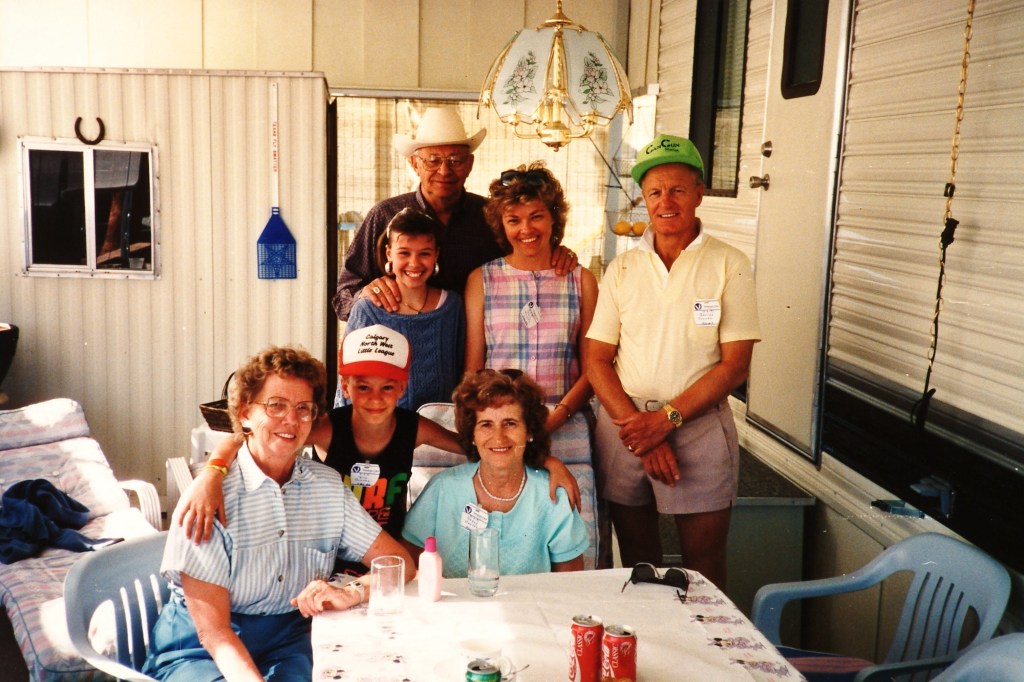
Happy times in Arizona ..Four Parents, our Two Kids and Me

Joan Craven is inviting you to a scheduled Zoom meeting.

TIME: 5 PM Monday March 15, 2021

Topic: First Reading of The Call ……a Memoir about my caregiving experience

Join Zoom Meeting
https://us04web.zoom.us/j/3172795761?pwd=YlZERjR3dWxkNlFVc0IwbUtEVFRvdz09

Meeting ID: 317 279 5761
Passcode: 5PXdW8

Just to give you a little background this is a draft of the introduction…….

I didn’t write for six years. My parents and my husband’s parents would be shocked and then heartbroken to think they caused my caregiver exhaustion. 

For thirty-seven years I was a first-line family caregiver. Bob’s parents left this world in 2009 and 2011; my dad passed away in 2015; and when mom passed away in 2017, I was physically, emotionally and mentally exhausted. Many days I became disheartened. Despite my best efforts, nothing I could do would ‘make it better.’

My supportive husband and brother lightened the load. We were not supplementing our parents’ income, as is the case with many family caregivers.

I had watched my own parents make decisions for their parents as my much-loved grandparent’s aged. It wasn’t a smooth process. For this reason they gave my brother and I clear direction as to what they wanted as they aged. We were given permission to have honest discussions with them if we noted things they did not. 

My in-laws were the opposite. They told us the only way they would leave their home was in a hearse. They did not want outside help and they did not talk about the ‘what if’s’ as they aged. 

As I reflect on my story, these questions came to mind:

  • What can I do to make it easier for my caregivers when the time comes ?
  • Could I have done things differently during my caregiving years?
  • What changes need to happen NOW provincially and federally with regard to care of seniors?

There is no other stage in life that requires so much preparation. For too long aging was something that simply happened. Many people thought it was out of their control. It is not.

Have you thought about these questions? 

  • Do you want to live as long as the medical establishment can keep you breathing? 
  • Do you value quality of days living healthy or quantity of days spent staying alive? 
  • Do you want to stay in your own home?  Have you considered the costs? What supports would need to be in place?
  • If you are deemed incapable of making decisions have you designated your caregiving team?

An article in the New York Times said “It takes a village to shepherd people through their golden years.” (Amy Blakestone, June 7, 2019)  As you assemble your team and make your wishes known only then can you be confident that those wishes will be followed. Will there be glitches? Of course. 

As uncomfortable it is, it’s time to think and then talk about the last chapter of our lives. Do you want to be in charge or do you want others trying to guess what they think you would want? It’s important to start your conversation today.

If you don’t think you need to do it now, look in the mirror, especially just after you crawl out of bed!  That’s an honest reality check. Remember that heroes act, despite their fear. Be a hero. Begin to prepare today.

I hope you will join me tomorrow, Monday March 15 at 5 pm. Bring a paper and pen as I will be asking for your reflections as you listen to one of my stories.

CARE FOR OUR ELDERS IS UNSUPPORTED, FRAGMENTED AND UNDERFUNDED

Neglected No More

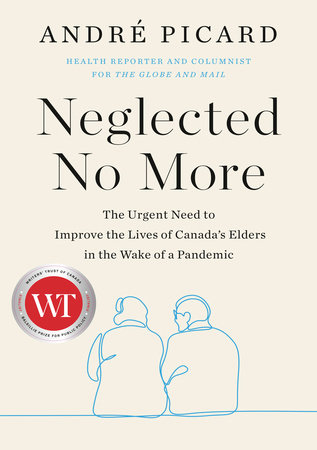
Every Baby Boomer needs to read this fact-filled book – Neglected No More, The Urgent Need to Improve the Lives of Candas Elders in the Wake of the Pandemic.

Canadian author Andre Picard tackles the subject and lays out the history of eldercare in our country. He shows us how it is fragmented, underfunded and unsupported.

Funding levels have not kept up with the the fact that people are living longer. When we live longer our medical needs become much more complex. It should not have been a surprise to those in charge that this was happening. Proper planning could have taken place, if anybody cared.

We knew In 1945 the average life expectancy for women was 68 and men 65. Now we are expected to live to 84 and 80 respectively.

In the introduction Picard says “this is a plea to stop dehumanizing elders.” The facts are sprinkled with real-life stories of seniors who have needed various forms of elder care and how ‘the system’ has continually failed.

Over the years aging in place has always been the preferred way to spend our Golden Years. Yet Picard tells about one family who spent $100,000 in one year, despite accessing all the government programs available, just to supplement the elder’s care. And the family didn’t feel the care was great.

It’s horrifying to think that there have been over 150 inquiries, parliamentary hearings, task forces and commissioned reports as to the sad state of long-term care, home care and eldercare. The same identified gaps are well documented, over and over. Yet nothing much has changed.

Various government departments (housing, social welfare or health) have elder care or long-term housing as part of their portfolio yet not one department has the actual responsibility to make changes. It’s time today to change that. Government decision makers please care enough to begin today!!!!!

Picard also talks about private versus public care. One story shows how as a father needed more and more care, the family was paying upwards of $8,000 per month. The family still supplemented the care with family members and hired help.

The last chapter of his book is titled “A Prescription for Reform.” Picard acknowledges it will be a monumental task and will take a dedicated group of decision makers to move the changes forward. The changes he recommends reflect the research and information he has gathered. Each ones makes sense.

We know when a world-wide crisis occurs things can change. We have seen it with the pandemic. Our politicians acted courageously. It’s time they did the same for the care of our elders.

Public policy needs to be written with clear responsibility lines. Politicians must act boldly across all levels of government, and deliverables and timelines written.

We have too many documents gathering dust that state definitively what needs to happen. Strategically thinking politicians be brave. Step up and show you care.

What is Keeping You Busy These Days? Is it Pickles, Pizza, Quilts and Memoirs?

Our isolation is looking to be longer than we expected. I can’t complain. Like most of our retired friends we are adapting well. We are reading more, watching more NETFIX and making sure we walk each day.

What I miss most is actually having a face-to-face visit. FaceTime and Zoom just aren’t the same. Better than nothing, just not the same. I want some hugs!

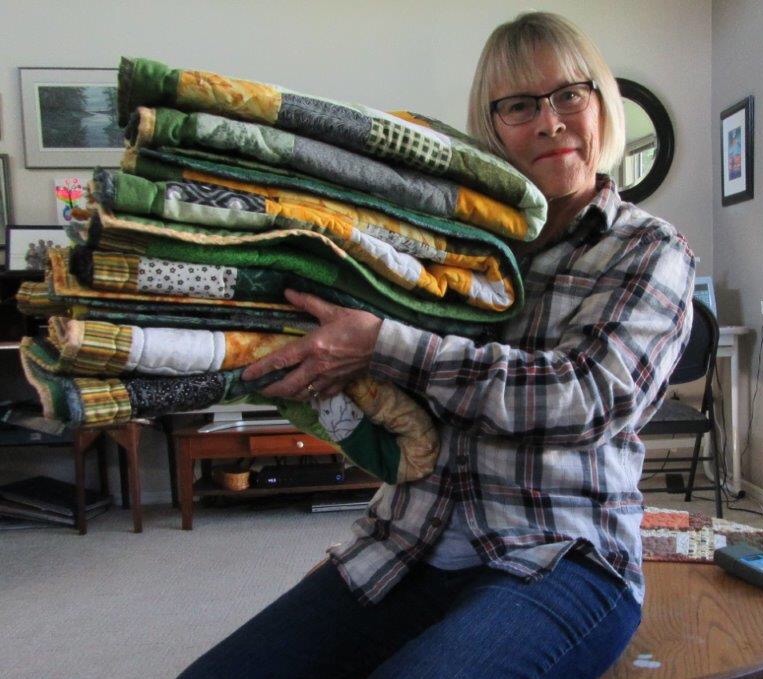
Many of my friends are quilters and sewers and they have completed some terrific projects. From quilts that Marg has completed you see here to another friend completing skirts for her granddaughter and another friend who is creating a variety of quilts and wall hangings.

Other friends are bakers. Sourdough is rising most days and no-knead bread is popular, not to mention cookies and squares. One friend passed along a recipe for quick pickles that she says her grandkids are wild about.

Here is the recipe:

Pat’s 48 Hour Pickles

4 tsp. sugar

4 cups white vinegar

1/4 cup coarse salt

1 tsp. mustard seed

1 tsp. tumeric

1 tsp. celery seed

Bring brine to a boil. Cool. Slice cucumbers thin. Quarter a large onion, then slice again. Alternate layers in sterilized jars.Pour brine over and marinate 48 hours.

Like many other friends I’m still trying out different recipes for meals. My husband is a good sport about the variety. One of our favourites right now is a pizza made with puff pastry. I buy the pastry so it’s quick and easy. I mostly followed a recipe created by The Pioneer Woman. I forgot to brush the pastry with olive oil and it was still good.

One project that has been keeping me busy these past months is that I am attempting to write a memoir. Another friend is also writing one, so we try to keep each other on track.

If you would like to hear more about what I’m doing I am hosting a virtual reading on March 15 at 5 pm MST. I thought it could be like a happy hour so bring your glass of wine to the ZOOM call.

I’m not quite sure how it will work. If you would like to participate please email me (joancraven@shaw.ca) with ZOOM MARCH 15 as the subject and then I will invite you once I set up the ZOOM call. It will be an experiment. I hope it works.

If you know of others who might be interested please let them know!

Crisis Conditions Persists In Long Term Care

If you think things are getting better in Long Term Care, think again. In the Sunday Toronto Star (February 7, 2021) newspaper there is a special section showing that Health Minister after Health Minister says things are going to change. To date not much has.

The articles outline appalling conditions and more horror as tragedy after tragedy unfolds. The reporters say as they researched the stories it became clear that they are writing the same stories as those getting written 5, 10 and even 20 years ago.

When is our Federal Government going to implement national standards? When are Long Term Care Administration and Boards (not staff) going to be held accountable? When are random inspections going to occur so deficiencies can be identified and plans put in place to address these ongoing issues?

Long Term Care Facilities do not need warnings. It’s time someone was held accountable.

I express my concerns to politicians both federally and provincially. I then receive a form letter from the provincial Health Care Minister and the Federal Minister from Seniors that essentially say they too are gravely concerned.

Yet exactly the same issues we heard about in the spring are occurring one year later. It doesn’t take a rocket scientist to realize that doing the same thing won’t have new results.

Before the government puts money toward Long Term Care, wouldn’t it be novel if they talked to the experts – those who work in the facility. Talk to the staff who care for the residents day to day not the Administration, the Board members or the Case Managers. Practical suggestions need to be heard.

Next they need to talk to family caregivers, who in most cases are supplementing the care their loved ones receive – or they were until the pandemic hit. Ask questions such as where do they see money being used for the benefit of the residents. Again practical suggestions would be offered.

Those of us who have navigated the complicated system to see that our loved ones receive quality care, know what is missing. We saw first hand gaps in services. It is certainly not the dedication of staff. They are working as hard as they can. Nowadays people in Long Term Care have more complex needs because we are all living longer.

Staff need to be offered full-time positions. There needs to be stability for the residents as well as the staff. This is not a new idea. It has been said over and over, especially since the pandemic.

Governments, Boards and Administration realized that having part-time positions was a cost-saving measure. This is criminal for staff as well as residents.

For seniors to have a constant parade of caregivers is confusing and even frightening. Staff need time to get to know their patients, learn of their likes and dislikes, and are able to build trust. A community is built. If staff have to work at two or three different facilities this cannot happen.

If you, as a future recipient of such care, want to change things it’s time to make Administration, Boards and Government departments of various Long Term Care Facilities accountable. Ask specific questions. Find out the name of the person responsible and address the letter or email to him or her.

Questions such as:

How many residents do you have?

Are there only single rooms with a private bath?

Do you have rooms for couples?

What is your target staff to resident ratio? How is this calculated? Who is included in calculations?

How many full time Licensed Practical Nurses do you have on staff daily? Are they available seven days a week?

How many part time Licensed Practical Nurses do you have on staff?

How many full time care aids are on staff daily?

How many part time care aids?

How many full time cleaning staff?

How many part time cleaning staff?

How many full time registered nurses?

How many part time registered nurses?

How many full time physical therapists?

How many part time physical therapists?

How many full time occupational therapists?

How many part time occupational therapists?

How many full time recreational therapists?

How many part time recreational therapists?

How many full time nurse practitioners?

How many part time nurse practitioners?

How many full time kitchen staff do you have?

How many part time kitchen staff do you have?

How many full time facilities staff are there?

How many part time facilities staff are there?

Do you have a volunteer coordinator??

Which positions are available seven days a week and which ones are only filled Monday to Friday.

It was my experience that my parents would fall ill Friday evening. The Registered Nurse and Nurse Practitioner were only available Monday to Friday. So a trip via ambulance to the hospital happened. It was a waste of resources for Emergency Medical Services, Emergency Room Services and was traumatic for residents.

Often a diagnosis of a recurring urinary tract infection took four to six hours in an emergency department to diagnose. Many residents became agitated and confused while being transported or while waiting. If a Registered Nurse or Nurse Practitioner was one site this could have been handled much more cost effectively as well as humanely.

What can we do? Continue to write letters and e-mails to those who make decisions. Contact the media to keep the care of those who built our country top of mind. If media write a story you enjoy, let them know. Perhaps you have follow up idea for them. Educate yourself as to the differences between private and publicly funded facilities.

If you are a baby boomer, chances are at some point you or someone close to you is going to need some sort of supportive care. It’s time to act to ensure changes are made. We can’t wait any longer.